
THE CLASSIFICATION OF WORDS
Date: 2015-10-07; view: 866.
§ 19. A morpheme usually has more than one meaning. This is the case, for instance, with both the lexical and the grammatical morpheme in the word runs. The morpheme run- has the following meanings: 1) "move with quick steps" (The boy runs fast); 2) "flow" (A tear runs-...); 3) "become" (to run dry); 4) "manage" (run a business); 5) "cause to move" (run a car), and many others. The meanings of the -s morpheme are as follows: 1) "present tense", 2) "indicative mood", 3) "third person", 4) "singular number", 5) "non-continuous aspect", and some others.
All the lexical meanings of the word runs, inherent in the morpheme run-, unite this word with to run, running, will run, shall run, has run, had run, is running, was running, etc. into one group called a lexeme.1
All the grammatical meanings of the. word runs, inherent in the morpheme -s, unite this word with walks, stands, sleeps, skates, lives and a great many other words into a group we shall call a grammeme 2.
The words of a lexeme or of a grammeme are united not only by the meanings of the corresponding morpheme, but by its form too. Still the content is of greater importance, the form often differing considerably. The words runs and ran, for instance, have the same lexical meanings and belong therefore to the same lexeme in spite of the formal difference (but see § 11). Even more significant is an example like buy and bought. But most striking are cases like go and went, I and me, etc. (see later, § 28). Similar examples can illustrate the formal variations of a grammatical morpheme uniting words into a grammeme: lived, walked, skated, slept, ran, went.
The number of words in an English lexeme may vary from one (must; milk; woolen; always) to several dozens (writes, wrote, will write, shall write, am writing, are writing, was writing, were writing, have written, has written, had written, is written, was written, etc.).
Note. The lexeme represented by write contains 94 words expressed by 64 forms, of these only 10 words have synthetic forms, five in number, Here they are:
1. write (infinitive, indicative, subjunctive, imperative)
2. writes
3. wrote (indicative, subjunctive)
4. writing (gerund, participle)
5. written
The number of words in a grammeme is usually very great, practically limitless. But occasionally a grammeme may contain one word only. For instance, the grammeme having the meanings of 'indicative mood', 'past tense', 'plural number', 'non-continuous aspect', and 'non-perfect order' (see § 212) contains but one word — were.
____________________
1 As already mentioned (§ 6), many grammarians use the term word with regard to such a group.
2 The term grammeme (grameme), with a different meaning, was used by K. Pike in Language in Relation to a Unified Theory of Human Behavior (1954—1955) and Grammemic Theory in Reference to Restricted Problems of Morpheme Classes (1957).In 1958 Pike replaced grammeme with Bloomfield's term tagmeme.
A. Juilland (Outline of a General Theory of Structural Relations. Monton, 1961) uses the terms lexeme, grammeme for 'roots' and 'non-roots'.
§ 20. From the previous paragraph it is clear that a word like runs containing a lexical and a grammatical morpheme is at the same time a member of a certain lexeme and of a certain grammeme. In a lexeme the lexical morpheme may be regarded as invariable (at least in content) and the grammatical morphemes as variables. In a grammeme, on the contrary, the grammatical morpheme is invariable and the lexical morphemes are variables. This can be seen from the following table.
| Lexeme 1 | Lexeme 2 | Lexeme 3 | ||
| Grammeme 1 | boy | girl | captain | common case, singular number |
| Grammeme 2 | boy's | girl's | captain's | possessive case, singular number |
| Grammeme 3 | boys | girls | captains | common case, plural number |
| Grammeme 4 | boys' | girls' | captains' | possessive case, plural number |
| male child, son, male servant, etc. | female child, daughter, maid servant, etc. | leader, chief, officer, etc. |  meanings of grammemes
meanings
of lexemes meanings of grammemes
meanings
of lexemes
|
As we see, each word of a lexeme represents a certain grammeme, and each word of a grammeme represents a certain lexeme. The set of grammemes represented by all the words of a lexeme is its paradigm. The set of lexemes represented by all the words of a grammeme is usually so large that it is almost of no practical value and has therefore got no name. The paradigms of the three lexemes in the table above are identical and characterize the lexemes as belonging to a class called nouns. The paradigm of the lexeme want, wants, wanted, shall want, etc. is quite different and stamps it as belonging to another class called verbs.
§ 21. There is an essential difference in the way lexical and grammatical meanings exist in the language and occur in speech. Lexical meanings can be found in a bunch only in a dictionary or in the memory of a man, or, scientifically, in the lexical system of a language. In actual speech a lexical morpheme displays only one meaning of the bunch in each ease, and that meaning is singled out by the context or the situation of speech (in grammar parlance, syntagmatically). As seen already (§ 19), words of the same lexeme convey different meanings in different surroundings. In the sentence The boy runs fast the word runs has meaning 1. In Л tear runs down her cheek it has meaning 2. In runs dry it conveys meaning 3. In runs a car — meaning 5, and so on.
The meanings of a grammatical morpheme always-come together in the word. In accordance with their relative nature (§ 10) they can be singled out only relatively in contrast to the meanings of other grammatical morphemes (in grammar parlance, paradigmatically). Supposing we want to single out the meaning of 'non-continuous aspect' in the word runs. We have then to find another word which has all the meanings of the word runs but that of 'non-continuous aspect'. The only word that meets these requirements is the analytical word is running. Runs and is running belong to the same lexeme, and their lexical meanings are identical. As to the grammatical meanings the two words do not differ in tense ('present'), number ('singular'), person ('third'), mood ('indicative'), etc. They differ only in aspect. The word runs has the meaning of 'non-continuous aspect' and is running — that of 'continuous aspect'. Thus all the difference in the forms of the two contrasted words serves to distinguish only these aspect meanings which are thus singled out from the whole bunch.
§ 22. When opposed, the two words, runs — is running, form a peculiar language unit. All their meanings but those of aspect counterbalance one another and do not count. Only the two particular meanings of 'non-continuous' and 'continuous' aspect united by the general meaning of 'aspect' are revealed in this opposition or opposeme, to use an -eme word (Cf. phoneme, morpheme, lexeme, grammeme). The general meaning of this opposeme ('aspect') manifests itself in the two particular meanings ('non-continuous aspect' and 'continuous aspect') of the opposite members (or opposites).
Now we may regard the word runs as representing the whole grammeme runs, walks, stands, sleeps, skates, lives, etc. Likewise, the word is running represents the grammeme is running, is walking, is standing, is sleeping, is skating, is living, etc. When contrasted the two grammemes can also be regarded as an aspect opposeme since they show the particular meanings of 'continuous' and 'non-continuous' aspects united by the general meaning of 'aspect'.
The pairs ran — was running, shall run — shall be running, to run — to be running, etc. and the corresponding grammemes are ail aspect opposemes with the same general meaning and identical particular meanings.
All the aspect opposemes make up a system which is called the category of aspect. Each opposeme represents the category as a molecule represents a certain substance, but the extent of the category is shown by the whole system of opposemes.
§ 23. The category of tense is the system of tense opposemes in a given language. A tense opposeme in English consists not of two but of three members (writes — wrote — will write; is writing — was writing — will be writing) because the general meaning of 'tense' manifests itself in three particular meanings: 'present', 'past' and 'future'. The pair is writing — was writing cannot be regarded as a tense opposeme because one particular manifestation of 'tense' (the 'future tense') is missing: will be writing. Neither can the group writes — wrote — was writing — will write be looked upon as a tense opposeme since the 'past tense' is manifested twice: in wrote and was writing. Besides, was writing introduces the 'continuous' meaning which the other members of the group do not possess.
In general, an opposeme of any grammatical category consists of as many members (or opposites) as there are particular manifestations of the general meaning. Thus, a morphological opposeme is a minimum set of words revealing (by the difference in their forms) only (and all) the particular manifestations of some general grammatical meaning. Any morphological category is the system of such opposemes whose members differ in form to express only (and all) the particular manifestations of the general meaning of the category.
§ 24. The structure of a lexeme is defined by the opposeme it contains. The lexeme represented by the word long, for instance, contains the opposeme of but one category, the 'degrees of comparison'. Its structure, therefore, is, so to say, of one dimension: long — longer — longest. The lexeme represented by the word boy contains opposemes of two categories, 'number' and 'case'. As a result, its structure is a two-dimension one:

Each category is represented here by two opposemes. In English there are no lexemes of three-dimension structure. If the infinitive were regarded as a separate lexeme, it could be a model of this kind:
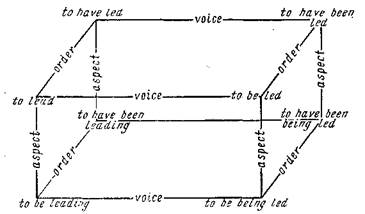
To be being led and to have been being led are rarely used (see John Millington-Ward. Pecularities in English. L., 1957, p. 250)
Here each category is represented by four opposemes.
The structure of an English verb lexeme containing opposemes of seven categories is so complicated that it is next to impossible to present it on paper.
§ 25. All the words of a lexeme, both synthetic and analytical, are, as defined (§ 19), united by the same lexical meanings.
Historically the analytical words have developed from combinations of two (or more) words. But the lexical meaning of only one word has been preserved, so that instead of belonging to two (or more) different lexemes the combination functions as a word of one lexeme.
We cannot agree with A. I. Smirnitsky that is and has in the analytical words is written, has written contain some weak lexical meanings. If it were so, writes — is written, writes — has written could not be regarded as grammatical opposemes, or as words of the same lexeme: they would differ lexically.
§ 26. Analytical words are closely connected with synthetic ones.
a) The very existence of analytical words depends on their correlation with synthetic words of the same lexeme. This makes all the difference between the analytical word is written and the combination is afraid. The opposeme writes — is written stamps is written as a word of the same lexeme to which the synthetic word writes belongs. Is afraid, am afraid, are afraid, was afraid, etc. have no synthetic opposites. Hence they are not analytical words, but combinations of words.
b) Analytical words comprise synthetic words. Thus, the analytical form has prepared consists of two synthetic forms: has (cf. had) and prepared (cf. prepare).
Hence it is clear that synthetic words play a very important role in the language.
§ 27. The means employed in English to distinguish the words of a lexeme are similar to those used to distinguish the stems of different lexemes. The chief of them are: affixation, sound interchangeand suppletivity.
The words play and plays are related by affixation: the word plays differs from the word play in having the affix, more exactly suffix, -s added to the stem of the lexeme. The stems speak- and speaker- are also related by affixation.
The words foot and feet are related by sound interchange, more exactly by vowel interchange (or internal inflection, see § 11). The stems full- and fill- are also related by vowel interchange. The stems speech- and speak- are related by consonant interchange. Different stems may contain the same root, e. g. compose, dispose, oppose, propose. Usually, however, there are different roots in different stems, e. g. replace, discover, forgive. But it is unusual for words of the same lexeme to have different roots, e. g. / — me, go — went. This unusual phenomenon is called suppletivity.
§ 28. As shown by A. I. Smirnitsky, words derived from different roots may be recognized as suppletive only under the following conditions:
1) When they are identical as to their lexical meaning.
2) When they mutually complement one another, having no parallel opposemes. For example, better has no other opposite of the positive degree but good and good has no opposite of the comparative degree but better.
3) When other lexemes of the same class build up a given opposeme without suppletivity, i. e. from one root. Thus, we recognize the words go — went as suppletive because they express exactly the same grammatical meanings as the opposemes come — came, work — worked, finish — finished, etc.
Of these conditions only the first two seem indispensable. The words am and is, for example, are suppletive in Modern English in spite of the fact that other verb lexemes do not build up the given opposeme (of person) without suppletivity.
§ 29. The above-mentioned criteria serve to prove the identity of lexical morphemes in spite of their difference in form. The same criteria can be used to prove the identity of any morphemes.
H. Gleason writes: "Two elements can be considered as the same morpheme if (1) they have some common range of meaning, and (2) they are in complementary distribution...".
By means of these criteria it is possible to prove, for instance, the identity of the 'plural' morphemes -s (in cows) and -en (in oxen):
1. They are identical as to their grammatical meaning.
2. They complement each other or, in other words, their distribution is complementary: they are not used with the same lexical morpheme. The word ox has no other 'plural' opposite but oxen (not oxes, for instance) and the word cow has no 'plural' opposite but cows (not cowen) 2.
____________________
2 Though there exists the obsolete and dialectal plural kine. Charles F. Hockett (Language. Vol. 23, No. 4, Oct. Dec. 1947) suggests to replace 'complementary distribution' by 'non-contrastive distribution', i. e. two elements may be in partial complementation, and in those environments in which both occur, they are in free alternation. "Thus the unaspirated [t] of stick and the aspirated [t'] of tick are both found as utterance-final and in other positions: He's in the skit may end with [t] and [t']. hoof and hoove /s/ and /z/ are in non-contrastive distribution: hoofs and hooves do not differ in meaning"... "The plural of brother 'fellow lodgeor church-member of the male sex' is either brothers or brethren in free alternation."
§ 30. We have already spoken (§§ 14, 15, 18) about lexico-grammatical morphemes and their functions as stem-building elements. Now we are to see their role in building up classes of words.
A lexico-grammatical morpheme like -er or -ize resembles a lexical morpheme in being common to all the words of a lexeme. Сотр. teacher, teacher's, teachers, teachers'; realize, realizes, realized, will realize, has realized, is realized, etc.
But it resembles a grammatical morpheme in being common to many different lexemes. Сотр. teacher, worker, leader, writer, reader, realize, nationalize, individualize, naturalize, industrialize, etc.
Hence we may draw the following conclusions:
1) The words of a lexeme are united not only by a lexical morpheme functioning as its root, but also by its lexico-grammatical morphemes functioning as its stem-building elements. In short, it is the stemthat unites words into a lexeme. To lay stress on the content we may say that a lexeme is a group of words united by the same lexical and lexico-grammatical meanings. Though the words person, personal, personality, personify, personification have the same lexical morpheme, they belong to different lexemes owing to their lexico-grammatical morphemes.
2) Lexico-grammatical morphemes unite lexemes into groups possessing common lexico-grammatical properties.
§ 31. Let us compare the following columns of words:
teach — teacher
work — worker
lead — leader
write — writer
read — reader
real — realize
national — nationalize
individual — individualize
natural — naturalize
industrial — industrialize
The words of column 1 and those of column 2 belong to different classes of lexemes. The same is true of the words of the last two columns.
These classes differ not only in their lexico-grammatical meanings (morphemes), but in some grammatical properties as well: different opposemes, paradigms, etc. Such classes of lexemes have been called parts of speech for over 2000 years. Therefore we dare not change the name. But we must remember that classes of units exist only in the system of a language. In speech we come across combinations of individual representatives of various classes.
Parts of speech are the largest word-classes that may contain endless numbers of word-groups such as lexemes or grammemes.
It is certainly easier to survey a limited number of parts of speech than an ocean of lexemes or grammemes. Therefore it has been a long-standing tradition to study the properties of words within the framework of parts of speach. The chapter headings of a book on morphology are usually the names of the parts of speech. We shall adhere to the tradition and after a chapter on the general criteria for dividing English words into parts of speech we shall analyse them one by one.
| <== previous lecture | | | next lecture ==> |
| THE STRUCTURE OF WORDS | | | THE COMBINABILITY OF WORDS |