
Well, have you decided on your future career yet?
Date: 2015-10-07; view: 570.
But, you don't have to do a fourth year. Three will give you a B.A.
How long are you going to study?
For four years.
Right. However, the fourth year gives you M.Math. For the three-year course you have to do a paper in something outside maths and for the four-year you really just do maths.
I'm still undecided. There are so many things you can do with maths –but definitely not a research mathematician. I don't think I'm good enough. I think a Masters degree is as far as my maths is capable of taking me.
(Adapted and abridged from http://plus.maths.org/issue28/interview/index.html
a) What reasons did Emily have for choosing Oxford University?
b) Why did she decide on the course in mathematics?
c) How long is the course?
d) How do studies at college differ from studies at school?
e) What qualification will she get?
f) What is Emily planning to do in future?
| Writing |
1. Application forms mostly ask for information rather than ask questions. Match a line in Awith a question in B.
| A | B |
| 1) First name | a) Where are you living at the moment? |
| 2) Surname | b) Are you married or single? |
| 3) Date of birth | c) Where were you born? |
| 4) Country of origin | d) What's your surname? |
| 5) Present address | e) Where do you live? |
| 6) Permanent address | f) What do you do? |
| 7) Marital status | g) When were you born? |
| 8) Occupation | h) How much do you earn? |
| 9) Annual income | i) What's your first name? |
2. Fill in the application form for admission. Write in block capitals. Put N/A if the information is not applicable. 
Application Form
for admission as an undegraduate student
1. Personal information
Title__________________________________________________________Mr/Mrs/Miss
Surname__________________________________________________________________
First Name(s)______________________________________________________________
Date of birth (use figures only): date__________ month_____________ year___________
Place of birth____________________________Citizenship_________________________
Home address: street and house_______________________________________________ city____________________country______________________postcode______________
Telephone (country, area code/phone number)____________________________________
Email____________________________________________________________________
Mailing address (if different from home address)__________________________________
_________________________________________________________________________
3. Prefered field of study
|
| Role play |
| Study help Make use of every opportunity you get to practice speaking in class. Role-plays help you prepare for a real-world experience. |
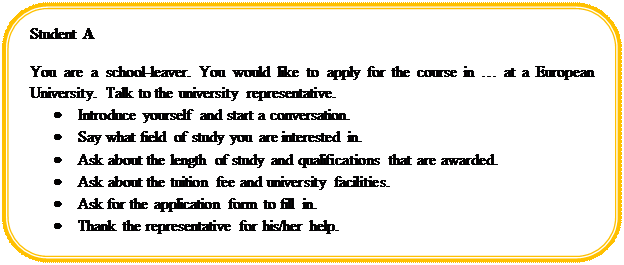
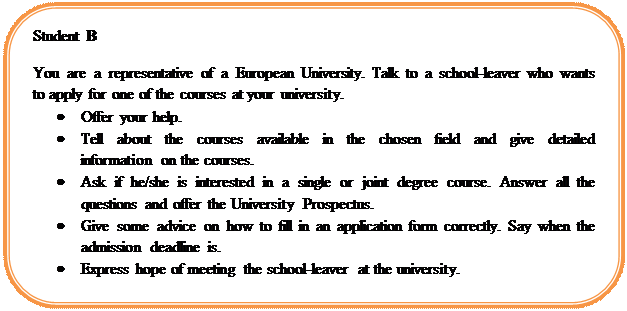
Work in pairs. One of you is a Russian school-leaver, the other represents a European University. You both meet at the Forum of Education Opportunities held in the school-leaver's hometown.
 |
| In the Realm of Science |
1. In education, as well as in many other spheres of our life, there are a great number of abbreviations. Read and remember the abbreviations to do with the degree titles, e.g. BS stands for Bachelor of Science. Do all of them have Russian equivalents?
| A.S. | Associate of Science (USA) |
| A.A. | Associate of Arts (USA) |
| A.A.S. | Associate of Applied Science (USA) |
| BS | Bachelor of Science |
| BA | Bachelor of Arts |
| MS | Master of Science |
| MA | Master of Arts |
| M.Math* | Master of Mathematics |
| M.Eng.* | Master of Engineering |
| MPhil* | Master of Philosophy (UK) |
| MBA | Master of Business Administration |
| PhD | Doctor of Philosophy |
| Hons3 | Honours |
| HND | Higher National Diploma (UK) |
| HNС | Higher National Certificate (UK) |
| FdA | Foundations degree in Arts |
| FdSc | Foundations degree in Sciences |
M.Math – professional (taught) degree
M.Eng. – research degree
MPhil - a university course that is of a higher level than a basic course
What degrees are awarded in Russian universities?
2. Read and remember some of the terms describing academic positions.
| a teacher | - | someone who teaches, especially someome whose job is teaching, especially in a school |
| a tutor | - | (BrE) someone who gives lessons to an individual student or a very small group (NAmE) an assistant lecturer in a college |
| a lecturer | - | (especially in Britain) someone who teaches at a university or college |
| a professor | - | (especially BrE) a university teacher of the highest rank |
| a full professor | - | (NAmE) a rank of university teacher, and not as a title |
| an associate professor | - | (in the US and Canada) a teacher at a college or university who has a rank just below the rank of a professor |
| an assistant professor | - | (in the US and Canada) a teacher at a college or university who has a rank just below the rank of an associate professor |
| staff | - | all the workers employed in an organization considered as a group (BrE) teaching staff Ç (BrE) (NAmE) the people who work at a school, college or university, but who do not teach students |
| faculty | - | (NAmE) all the teachers of a particular university or college |
| a visiting professor | - | someone who has a job at one school but works at another for a period of time. |
| an adjunct professor | - | someone who is on a part-time position, to do research or teach classes. |
| professor Emeritus | - | someone with a title showing that the person, usually a university teacher, keeps the title as an honour, although he or she has stopped working |
| an instructor | - | someone who teaches sb a practical skill or sport; (NAmE) a teacher below the rank of assistant professor at a college or university |
| a coach | - | someone who trains a person or team in sport, and helps them to improve their skills |
| a trainer | - | someone who trains people in the skills they need to do a job |
| an educator | - | someone who teaches in a school, college, or university and who is an expert in the theories and methods of education |
(Longman Language Activator)
Unit 1. Progress Monitoring
In this unit you have worked on the vocabulary related to the topic “Higher education”
Tick (V) the points you are confident about and cross (X) the ones you need to revise. |
| Unit 2 There is So Much to Study in Science | ||
| Lead in | ||
1. Look at the diagram of the natural sciences and their terms. Work in teams and add four more terms of your own that go with the particular science.

2. Look at the definition of biochemistry below. Work with a partner. Give a definition of your field of study using the verbs from the Functional language box.
Example: Biochemistry examines the structure and function of living organisms
at the molecular level.
| Functional language: Giving definitions … is a science / study of … … studies/examines/investigates/etc. … … describes/deals with/determines/etc. … … uses/analyses/focuses on/etc. … |
| Reading |
1. Look through the definitions of some natural sciences dealing with environmental issues. Match the definitions with the right titles of sciences below. Mark the key words in each definition that helped you to make the right guesses. A is done as an example.
Study help
Choosing techniques appropriate for your reading goals can save you time.
Here are some reading techniques you may find helpful for reading efficiently—quickly and with good understanding.
|
A…is concerned with the health of our environment and the significance of pollution. It focuses around our ability to improve our understanding of the effects of pollution on plants and animals and to develop early warning markers of organisms, population or environmental health.
B…uses a high level of mathematical technique for the description and analysis of complex environmental systems. It needs complicated statistical methods in the design of experiments and interpretation of measurements in the monitoring of the environment…
C…uses scientific background to the processes which affect the environment and its management as well as considering the social, legal and policy implications of environmental issues.
D…is the scientific study of chemical and biochemical phenomena that occur in natural places. It deals with the behaviour of both natural and man-made substances in relation to atmospheric, aquatic and terrestrial environment.
E…is the science of the relationship between organisms and their environments. It is the study of harmful effects of modern civilization on the environment, with a view toward prevention or reversal through conservation.
(Adapted from Lancaster University Undergraduate Prospectus Entry 2005)
| 1. Pollution Science - A | 2. Ecology |
| 3. Environmental Management | 4. Environmental Chemistry |
| 5. Environmental Mathematics |
| Writing | 
|
Write the definition of your field of study. Pay attention to the key words you use.
| Listening |
1. Work with a partner. Choose the correct explanation of the words and phrases below. Use a dictionary if necessary.
1. If something is hands-onit is
a) theoretical b) practical c) both
2. If something is promising it
a) is bad and useless b) is unknown c) shows potential
3. If something captivated you it was
a) dead boring b) fascinating and attractive c) absolutely new to you
4 If something is familiar to you it is
a) well-known b) strange c) clear
5. If it is a procedure of something it is
a) a process or method b) a rule c) an explanation
6. If you hesitate you feel
a) brave b) unhappy c) uncertain
7. If you have a doubt about something you
a) feel scared b) hesitate c) feel angry
8. If you decide to broaden your knowledge of a subject you
a) forget about it b) think about it a lot c) learn more about it
9. If you are inquisitive you
a) are talented b) are imaginative c) want to know
more about people or things
2. Listen to John, Paul and July telling how they got interested in science. Tick (V) the correct piece of information about them.
| Who…? | John | Paul | July |
| · got interested by educational TV programs | |||
| · loved reading science fiction books | |||
| · was encouraged by their parents | |||
| · is fond of experimenting | |||
| · is going to become a research scientist | |||
| · has a particular career in mind | |||
| · hasn't decided yet what to do in the future |
3. Listen again and answer the questions.
a) Are they all happy with their choice of specialization?
b) Why can interest in science mean a future full of choices?
c) What are the possible disadvantages of being a research scientist?
| Speaking |
Work with a partner, ask each other the questions below.
Ø Are you happy with the choice of your subject area? Why?/Why not?
Ø How did you get interested in it?
Ø What are your plans for the future? Do you have any particular career in mind?
Ø Would you like to become a research scientist? Why?/Why not?
Ø What else except for an inquisitive mind one should have to be a research scientist?
Ø Do you agree that successful scientists are born rather than made? Why?/Why not?
| Writing |
|
Write a paragraph about your partner's choice of the subject area using his/her answers to the questions above and the information in the Study helpbox as the guidelines to help you to organize your ideas and develop a good piece of writing.
| Study help - A paragraph is a group of related sentences that develop an idea. - In a paragraph there is usually one idea that is more important than all the others and it is commonly found at the beginning. - The main idea is supported by major details that grow out of it. And there are also minor details that grow out of the major ones, i.e. examples, explanations, additional information, etc. - When you write, try to join your ideas with the linking words and phrases, e.g. first of all, moreover, besides, finally, actually, in any case. - When you have finished, re-read and check your work. |
| Reading |
1. You are going to read the text about the Combined Science (Natural Sciences) course. Work with a partner and make a list of subjects that you think are included in the curriculum.
2. Read the description of the Combined Science degree course offered in Lancaster University in the UK and check the predictions you have made.
Guess the meaning of the highlighted words. Check as a class.
|

(Adapted from Lancaster University Undergraduate Prospectus Entry 2005)
3. Read the text again and answer the questions.
a) How many departments are involved in training students in the Combined
Science course?
b) Who may find this course most attractive?
c) Does the combined course provide any particular career opportunities? What are they?
d) How many natural science subjects can a student take?
e) Who can help students to make the right choice of the subjects?
| Study help We remember new words much more easily if we think about them in relation to our own experience and if they have some personal meaning for us. |
4. Match each item on the left with an
item on the right to make a phrase commonly used in English. Use prepositions where necessary.
| specialized current wide personal barriers a wide range programme provide academic forward mature | of between | study requirements subjects excellence choice education student thinking interest a means of areas |
| <== previous lecture | | | next lecture ==> |
| What do you mean? | | | Focus on Language |