
MAGNETIC FIELDS AND FORCES
Date: 2015-10-07; view: 645.
In our study of electricity, we described the interactions between charged objects in terms of electric fields. An electric field surrounds any electric charge. In addition to containing an electric field, the region of space surrounding any moving electric charge also contains a magnetic field. A magnetic field also surrounds a magnetic substance making up a permanent magnet.
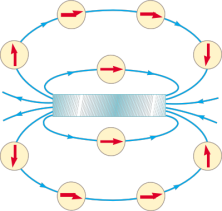 Fig.7.
|
Figure 7 shows how the magnetic field lines of a bar magnet can be traced with the help of a compass. The magnetic field lines outside the magnet point away from north poles and toward south poles.
We can define a magnetic field Bat some point in space in terms of the magnetic force  that the field exerts on a charged particle moving with a velocity v, which we call the test object. For the time being, let us assume that no electric or gravitational fields are present at the location of the test object. Experiments on various charged particles moving in a magnetic field give the following results:
· The magnitude  of the magnetic force exerted on the particle is proportional to the charge q and to the speed vof the particle.
· The magnitude and direction of depend on the velocity of the particle and on the magnitude and direction of the magnetic fieldB.
· When a charged particle moves parallel to the magnetic field vector, the magnetic force acting on the particle is zero.
· When the particle's velocity vector makes any angle θ  0 with the magnetic field, the magnetic force acts in a direction perpendicular to both v and B; that is, is perpendicular to the plane formed by vand B.
· The magnetic force exerted on a positive charge is in the direction opposite to the direction of the magnetic force exerted on a negative charge moving in the same direction.
· The magnitude of the magnetic force exerted on the moving particle is proportional to sin θ, where θ is the angle the particle's velocity vector makes with the direction of B.
We can summarize these observations by writing the magnetic force in the form = qv×Bwhich by definition of the cross product is perpendicular to both v and B. We can regard this equation as an operational definition of the magnetic field at some point in space. That is, the magnetic field is defined in terms of the force acting on a moving charged particle. is zero when vis parallel or antiparallel to B(e = 0 or 180°) and maximum when vis perpendicular to B(e = 90°).
There are several important differences between electric and magnetic forces:
· The electric force acts along the direction of the electric field, whereas the magnetic force acts perpendicular to the magnetic field.
· The electric force acts on a charged particle regardless of whether the particle is moving, whereas the magnetic force acts on a charged particle only when the particle is in motion.
· The electric force does work in displacing a charged particle, whereas the magnetic force associated with a steady magnetic field does no work when a particle is displaced because the force is perpendicular to the displacement.
The SI unit of magnetic field is the newton per coulomb-meter per second, which is called the Tesla (T). A non-SI magnetic field unit is called the Gauss (G).
If a magnetic force is exerted on a single charged particle when the particle moves through a magnetic field, a current-carrying wire also experiences a force when placed in a magnetic field.
Field created by a long, straight current-carrying wire:
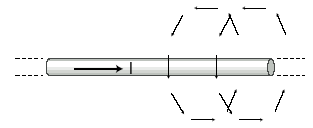 Fig.8. Fig.8.
|
 ,where r is the distance from the center of the wire. The field vectors trace circles in planes perpendicular to the wire, going clockwise when viewed from along the direction of the current (Fig. 8). Field created by a single loop of current:
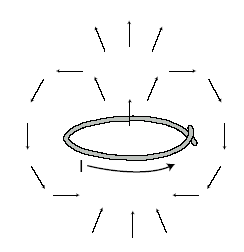 Fig. 9.
|
 I
I  , where b is the radius of the loop and z is the distance of the point from the plane of the loop (Fig. 9).
Field created by a solenoid (cylindrical coil)(Fig. 10):
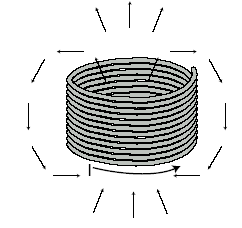 Fig.10.
|
The field pattern is similar to that of a single loop, but for a long solenoid the paths of the field vectors become very straight on the inside of the coil and on the outside immediately next to the coil. For a long solenoid, the interior field also becomes very nearly uniform, with a magnitude of B = μ  IN/l, where N is the number of turns of wire and l is the length of the solenoid. The field near the mouths or outside the coil is not constant and more difficult to calculate. For a long solenoid, the exterior field is much smaller than the interior field (from ‘Physics for Scientists and Engineers').
Exercise 77. Answer the following questions.
1. How is a magnetic field created?
2. What symbol is used to represent a magnetic field?
3. What direction do the magnetic field lines point?
4. How can a magnetic field be defined?
5. What results do experiments on charged particles moving in a magnetic field give?
6. What is the magnetic force?
7. What are the differences between the electric and magnetic forces?
8. What is the unit of a magnetic field?
9. How is field created by a long straight current-carrying wire?
10. How is field created by a single circular loop of current?
11. How is field created by a solenoid?
Exercise 78. You can see eight sentences describing some characteristics of the electric and the magnetic fields. Write them down into the appropriate column.
| <== previous lecture | | | next lecture ==> |
| Reading | | | Electric Field vs Magnetic Field |