
ELECTROMAGNETIC WAVES
Date: 2015-10-07; view: 880.
Pre-reading task
Active vocabulary
Unit 8. Electromagnetic Spectrum.
1. Electric arc [ɪˌlektrɪk'ɑːk] електрична дуга, дуговий
розряд
2. Electromagnetic radiation електромагнітне
[ɪˌlektrə(u)mæg'netɪkˌreɪdɪ'eɪʃ(ə)n] випромінювання
3. Electromagnetic spectrum спектр електромагнітних
[ɪˌlektrə(u)mæg'netɪk'spektrəm] хвиль
4. Electromagnetic wave електромагнітна хвиля
[ɪˌlektrə(u)mæg'netɪk'weɪv]
5. (To) emit [ɪ'mɪt] випромінювати
6. Gamma rays ['gæməreɪz] гамма-проміння
7. Infrared [ˌɪnfrə'red] інфрачервоний, інфрачервоне випромінювання
8. Microwave ['maɪkrəweɪv] мікрохвильовий, мікрохвиля
9. Radio wave ['reɪdɪəuweɪv] радіохвиля
10. Ultraviolet [ˌʌltrə'vaɪələt] ультрафіолет(овий), УФ-випромінювання
11. Visible light ['vɪzəb(ə)l'laɪt] видиме світло, хвилі видимої частини спектру
12. Wavelength ['weɪvleŋθ] довжина хвилі
13. X-radiation ['eksˌreɪdɪ'eɪʃən] рентгенівське випромінювання
14. X-ray ['eksreɪ] рентгенівський промінь
Exercise 102. In pairs, answer the following questions.
1. What waves of the electromagnetic spectrum do you know?
2. Give several examples of electromagnetic waves that are encountered in everyday life.
Exercise 103. Read, translate the text and answer the questions below it.
Light is energy that is emitted by accelerating charges – often electrons in atoms. This energy travels in a wave that is partly electric and partly magnetic. Such a wave is an electromagnetic wave. So, an electromagnetic wave is composed of oscillating electric and magnetic fields that regenerate each other. Electromagnetic waves move outward from a vibrating charge. No medium is required. At any point of wave, the electric field is perpendicular to the magnetic field, and both are perpendicular to the direction of motion of the wave. Electromagnetic waves move at the speed of light – no matter what the frequency or wavelength or intensity of the radiation.
The electromagnetic spectrum is a continuous range of waves extending from radio waves to gamma rays (Fig. 11). The electromagnetic spectrum consists of radio waves, microwaves, infrared, visible light, ultraviolet rays, X-rays and gamma rays.
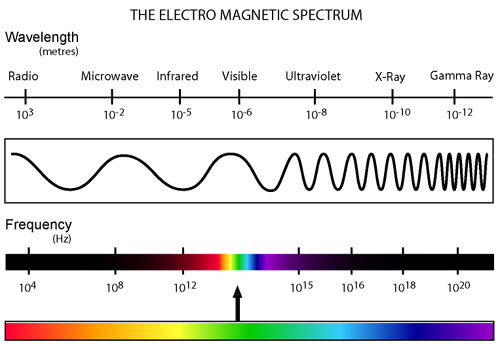 Fig. 11. Electromagnetic spectrum.
|
Radio waves have wavelengths that are comparable to the size of a radio antenna, i.e. meters to tens of meters. Radio waves are produced by changing currents in a conductor. They can be used in media and communication.
Microwaves were named so because they have much shorter wavelengths than radio waves. When food heats unevenly in a microwave oven, the small distances between neighboring hot and cold spots is half of one wavelength of the standing wave the oven creates. Microwaves are produced by changing currents in a conductor and can be used in microwave cooking and communication devices (mobile phones, etc).
Infrared (IR) light is electromagnetic radiation with a wavelength longer than that of visible light. This wavelength corresponds to a frequency range of approximately 1 to 400 THz, and includes most of the thermal radiation emitted by objects near room temperature. Microscopically, IR light is typically emitted or absorbed by molecules when they change their rotational-vibrational movements. Infrared light is used in industrial, scientific, and medical applications. Night-vision devices using infrared illumination allow people or animals to be observed without the observer being detected. In astronomy, imaging at infrared wavelengths allows observation of objects obscured by interstellar dust. Infrared imaging cameras are used to detect heat loss in insulated systems, observe changing blood flow in the skin, and overheating of electrical apparatus.
The visible spectrum is the portion of the electromagnetic spectrum that is visible to the human eye. Electromagnetic radiation in this range of wavelengths is called visible light or simply light. A typical human eye will respond to wavelengths from about 390 to 750 nm (frequency – 400–790 THz). A light-adapted eye generally has its maximum sensitivity at around 555 nm (540 THz), in the green region of the optical spectrum. The spectrum does not, however, contain all the colors that the human eyes and brain can distinguish. Unsaturated colors such as pink, or purple variations such as magenta, are absent, for example, because they can be made only by a mix of multiple wavelengths.Visible lightis emitted by the Sun. Intense light can damage your sight.
Ultraviolet (UV) light is electromagnetic radiation with a wavelength shorter than that of visible light, but longer than X-rays, in the range 10 nm to 400 nm. It is named because the spectrum consists of electromagnetic waves with frequencies higher than those that a human identifies as the colour violet. These frequences are invisible to a human, but visible to a number of insects. UV light is found in sunlight and is emitted by electric arcs and specialized lights such as black lights. It can cause chemical reactions, and causes many substances to glow or fluoresce. Although ultraviolet radiation is invisible to the human eye, most people are aware of the effects of UV through sunburn, and in tanning beds. Ultraviolet is also responsible for the formation of vitamin D in all organisms. The UV spectrum thus has many effects, both beneficial and damaging, to human health.
X-radiation (composed of X-rays) is a form of electromagnetic radiation. X-rays have a wavelength of 10 to 0.01 nanometers, frequencies from 30 petahertz to 30 exahertz. They are shorter in wavelength than UV rays and longer than gamma rays. X-rays are emitted by electrons outside the nucleus. X-rays can penetrate into solid objects, and their largest use is to take images of the inside of objects in diagnostic radiography and crystallography. X-rays have a wide variety of medical uses such as: in medical imaging (e.g. CN scans – computed tomography), for diagnostic purposes (X-rays are especially useful in the detection of pathology of the skeletal system). They are also used in airport security baggage scanners. X-rays are hazardous because they cause damage at a cellular level; and thus they can cause cancer by damaging cells.
Gamma rays or gamma radiation is electromagnetic radiation of high frequency (very short wavelength). They are produced by sub-atomic particle interactions such as radioactive decay, fusion, fission etc. Gamma rays have frequencies 1020 Hz, and therefore have energies above 100 keV and wavelength less than 10 picometers, often smaller than an atom. Gamma-rays have a wide variety of medical uses such as: in CT scans and radiation therapy, gamma rays are used to treat some types of cancer killing cancerous cells (so called gamma-knife surgery) and for diagnostic purposes in nuclear medicine. Gamma ray can be also used for measuring the thickness of materials. However, gammar rays are hazardous because they cause damage at a cellular level, and they can cause cancer by damaging cells (from ‘Conceptual Physics').
1. What is an electromagnetic wave?
2. How is an electromagnetic wave created?
3. How fast does an electromagnetic wave move?
4. Name all the parts of the spectrum (from longest to shortest wavelength).
5. What waves are dangerous?
6. Circle the letter beside each statement that correctly describes electromagnetic waves.
a) No medium is required to produce the waves.
b) The electric field is parallel to the magnetic field in the waves.
c) The waves move outward in all directions from the vibrating charge the created them.
d) Both electric and magnetic fields are perpendicular to the direction of motion of the wave.
Exercise 104. Circle the correct answer.
1. Which of the following is correct in order of lowest to highest frequency?
a) X-rays, visible Light, microwave
b) Ultraviolet, visible Light, gamma rays
c) Microwave, visible Light, gamma rays
2. This type of emission maps the dust between stars.
a) Infrared c) X-rays
b) Ultraviolet d) Gamma-rays
3. Gas in space emits radio waves.
a) True b) False c) We don't know
4.This type of emission can come from radioactive materials.
a) Radio b) X-rays c) Gamma-rays
5. It's possible to produce electromagnetic waves by shaking a charged rod back and forth in empty space.
a) True b) False
Exercise 105. Fill in the table “Electromagnetic Waves”.
| Produc-tion | Uses | Hazards | Wave-length (m) | Frequ-ency (Hz) | |
| Gamma rays | Emitted during radioac-tive decay | Measuring the thickness of materials, medical uses | Causes cancer by damaging cells | × 
| ×10 
|
| X-rays | |||||
| Ultra-violet | |||||
| Visible light | |||||
| Infra red | |||||
| Micro-waves | |||||
| Radio-waves |
Exercise 106. Match the items on the right to the items on the left to assemble the waves in the correct order.
1. Radio waves a) the highest frequency waves in the EM spectrum
2. Microwaves b) these waves are used to inspect luggage in airport security
3. Gamma rays c) these waves make your gin & tonic glow.
4. Infra red d) emitted by the laser in CD & DVD drives
5. Light e) the waves used for TV remote controls
6. Ultra violet f) used for mobile phones and radar
7. X-rays g) these waves have the longest wavelength in the EM spectrum
Exercise 107. Find the term in the puzzle that fits each clue given below. Then write the term on the line next to the clue.
1.Energy emitted into the air and received by your boom box.
2. Energy from these will cook popcorn.
3. Large balls of gas that create and emit their own radiation.
4. This type of radiation is normally felt as heat.
5. The part that our eye can see.
6. A source of ultraviolet radiation.
7. Distance between adjacent peaks in a series of periodic waves.
8. This radiation is abbreviated as UV.
| - |
9. A doctor uses these to look at your bones.
10. Energy radiated in the form of waves.
11. Radioactive materials can emit these.
12. Measured in cycles per second.
| <== previous lecture | | | next lecture ==> |
| Writing | | | Grammar. Infinitive and Gerund. |