
Task 6. Match the pictures and terms in column A with their definitions in column B
Date: 2015-10-07; view: 601.
Task 5. Write 5 different type questions to the text. Ask your groupmate to answer them
| A | B | ||
Single-Row Radial 
| A | This bearing provides for heavy radial and light thrust loads without increasing the OD of the bearing. It is approximately 60 to 80 percent wider than a comparable single-row bearing. Because of the filling slot, thrust loads must be light. | |
Maximum Capacity 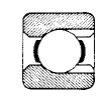
| B | These bearings are designed to support combined radial and thrustloads or heavy thrust loads depending on the contact-angle magnitude. Bearings having large contact angles can support heavier thrust loads. | |
 Double-Row Double-Row
| C | This type of bearing is used for linear motions on hardened shafts (Rockwell C 58 to 64). Some types can be used for linear and rotary motion. | |
Internal Self-Aligning Double-Row 
| D | This bearing is often referred to as the deep grooveor conrad bearing. Available in many variations - single or double shields or seals. Normally used for radial and thrust loads (maximum two-thirds of radial). | |
Angular-Contact Bearings 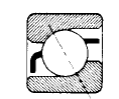
| E | They may be mounted in pairs (back-toback, tandem, or face-to-face) Tse bearings (ABEC-7 or ABEC-9) may be preloaded to minimize axial movement and deflection of the shaft | |
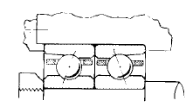 duplex bearings duplex bearings
| F | The geometry is similar to that of a deep-groove bearing except for a filling slot.This slot allows more balls in the complement and thus will carry heavier radial loads. However, because of the filling slot, the thrust capacity in both directions is reduced drastically. | |
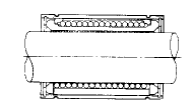 Ball Bushings Ball Bushings
| G | This bearing may be used for primarily radial loads where self-alignment(64°) is required. The self-aligning feature should not be abused, as excessive misalignment or thrust load (10 percent of radial) causes early failure. |
| <== previous lecture | | | next lecture ==> |
| BEARING CLOSURES | | | Requires system considered rotational selection |