
PHONETICS PHONOLOGY
Date: 2015-10-07; view: 1295.
SOUNDS
PHONETICS AND PHONOLOGY
General Linguistics
(5th year)
Workshop 1:
 |
 |
of speech (material sounds) of language (abstract sounds, sound types)
|
| ||||||||
 | |||||||||
 | |||||||||


| |||
 |
· Acoustic Phonetics, or acoustics of speech, studies physical properties (pitch, loudness, length, timbre, etc.) of audible speech sounds. Acoustic phonetics uses various instrumental techniques of investigation to provide an objective account of speech patterns related to the way sounds are produced and heard.
· Articulatory Phonetics, or physiology of speech, studies articulation of sounds with regard to the organs of speech.
· Organs of speech. (See 1; 2; 4).
· Stages of articulation:the on-glide, the retention stage, and the off-glide. Merging of stages and interpenetration of stages. (See 3).
· Articulatory basis of a language is the scope of all movements performed by the organs of speech to produce the sounds of this language. Articulatory bases of different languages do not coincide.
* * *
· Phonology vs. Phonetics. While phonetics studies material, or physical, sounds of speech, phonology studies sound types, or abstract sounds of language. Phonology highlights the functions of sound types, i.e. their ability to differentiate between meanings.
· A phoneme is the smallest linguistic unit (a sound type) that serves to differentiate between meanings. E.g. the meanings of words: /bid/ – /bi:d/ – /bo:d/; the meanings of word-forms: /gu:s/ – /gi:s/, /spend/ – /spent/. A phoneme, as a sound type, is represented by its allophones. Allophonesare positional variants of one and the same phoneme. Unlike phonemes, allophones do not differentiate between meanings. E.g. short and long vowels in Ukrainian; aspirated and non-aspirated consonants in English. (See 4).
· Theory of the phoneme. The Prague Linguistic School (N.S. Trubetskoi, A. Martine) defined the phoneme as a constituent of the sound form of words. Such elements are similar in different words. Comparison of words and word forms which differ in one sound results in distinguishing phonemic oppositions, or contrasting pairs of sounds (minimal pairs). Such oppositions can be of various types. The Copenhagen Linguistic School (L. Helmslev) also regarded the phoneme as a component of words or word forms. Besides, it was emphasized that the phoneme has no meaning of its own, but it helps to differentiate between the meanings of larger units. The American School of Descriptive Linguistics (K.L. Pike, Ch. Hockett) introduced the definition of an allophone as a positional variant of one and the same phoneme. The school considered various types of contexts (distributions) in which phonemes may occur.
There were differences in interpretation of the phoneme by the Moscow and Leningrad Phonological Schools. The Moscow Phonological School (R.I. Avanesov, P.S. Kuznetsov, A.A. Reformatsky) considered the phoneme as the smallest sound unit and a constituent of the sound form of morphemes and words. The basic variant of a phoneme (its invariant) is represented in its strong position, when a phoneme differentiates between the meanings of words and morphemes. The sounds make up a phoneme if they occur in one and the same position in the morpheme. E.g. Russ. /д/, /т/ in /сад-ы/ and /сат/ ‘сад'; /т'/, /т/ in /п'ат'/ ‘пять' and /п'ат-ый/ ‘пятый'. The Leningrad Phonological School (L.V. Sherba, L.R.Zinder, M.I. Matusevich) maintained that a phoneme is made up by the sounds which are similar acoustically, and which are associated with one and the same meaning. A phoneme is an autonomous unit; it does not depend on the position of the sound in a morpheme. The sounds belong to different phonemes if one can find in the language even one pair of words or word forms where these sounds differentiate between meanings. E.g. Russ. /д/, /т/ in /дом/ and /том/; /т'/, /т/ in /рат/ ‘рад' and /рат'/ ‘рать'.
· 


 Segmental phonemesare chunks, or segments, of different sounds, e.g. /b/, /t/, /e/, /I/, etc. Non-segmental phonemesare various tones that help to distinguish meanings, e.g. Chinese: ma [ ] – ‘mother'; ma [ ] – ‘hemp', ma [ ] – ‘scold', ma [ ] – ‘horse'. (See 4).
· Integral features of phonemes are the features shared by some phonemes; such features are considered when phonemes are united into groups, e.g. Engl. /n/, /n/, /m/ are nasal sounds; /p/, /t/, /k/ are aspirated sounds. Differential features of phonemes are the features that differ phonemes from one another. Such features are exposed in phonemic oppositions.
· Phonemic oppositions are the pairs of phonemes that have integral features, being opposed to each other by one or several differential features. The major types of phonemic oppositions are: (1) one-feature opposition, where the phonemes have one differential feature, e.g. Engl. /t/ :: /d/ – voiceless :: voiced; Ukr. /т/ :: /т'/ – hard :: soft; (2) multi-feature opposition, where the phonemes have several differential features, e.g. Engl. /p/ :: /z/ – voiceless :: voiced, labial :: lingual, occlusive :: constrictive; (3) typical opposition, which is revealed in a number of sound pairs, e.g. /p/ :: /b/, /t/ :: /d/, /k/ :: /g/, etc. – voiceless :: voiced; (4) isolative opposition, where the opposed phonemes belong to different languages, e.g. Ukr. /в/ :: Engl. /w/.
· The strong position of a phoneme is such a position where the features of a phoneme are most distinct. Vowels are in their strong position when they are stressed. Consonants are in their strong position when they stand before a vowel or a sonorous consonant.The weak position of a phonemeis such a position where some features of a phoneme become indistinct or they can even disappear. Vowels are in their weak position when they are unstressed. Consonants are in their weak position when they stand before noise consonants or at the end of a word.
· Neutralization of phonemic oppositions occurs in a one-feature opposition, when one of its members loses its differential feature while used in a weak position. Thus, the opposition is reduced to one member. E.g. Russ. /д/ :: /т/ à /т/ in /кот/ ‘код' :: /кот/ ‘кот'.
· Phonetic and phonemic transcriptions.Transcription is a method of writing down speech sounds in a systematic and consistent way. In phonetic transcription, the symbolized sounds are allophones that preserve their articulatory / auditory identity. Phonetic transcription is given in square brackets: [t]. In phonemic transcription, the symbolized sounds are phonemes, or “generalized sounds” which have a linguistic function, i.e. which differentiate between meanings. Phonemic transcription is given in slanted brackets: /t/.
· Spelling and pronunciation. Pronunciation and spelling do not coincide. Between them, there are different degrees of divergence exhibited by various principles of orthography, or the system of spelling rules.
(1) Orthography based on the phonetic principle most closely relates to pronunciation: the words tend to be spelt as they are pronounced. This principle is typical of Byelorussian and Serbo-Croatian. E.g. Byelorussian вада, карова, лес – лясы, стол – сталы.
(2) Orthography based on the morphological principle means that a morpheme retains its spelling, irrespective of the changes in its pronunciation. Ukrainian and Russian set the examples of languages where this principle is observed. E.g. Ukr. водний – вода; Russ. дом – домашний.
(3) Orthography based on the historical- traditional principle exhibits the most considerable divergence between pronunciation and spelling. In many cases spelling, which was motivated before, becomes non-motivated later. Still, it is preserved, being linked to pronunciation by convention. This principle is obvious in English. E.g. night OE /`ni:ht/ à CE /`nait/. Cf. also brought /`bro:t/, exhaust /ig `zo:st/, campaign /k m` pein/.
* * *
· Vowels vs. consonants.
(1) Acoustic feature: vowels are produced without noise, only voice (tone) is heard; consonants are always produced with noise.
(2) Articulatory features:
(a) vowels are produced without an obstruction to the air stream; consonants are produced with an obstruction to the air stream;
(b) in the production of vowels the tension of the organs of speech is not localized at a particular place; in the production of consonants the tension of the organs of speech is localized at the place of obstruction;
(c) in the production of vowels the air stream is weak; in the production of consonants the air stream is strong.
(3) Functional feature: vowels form syllables; most consonants do not form syllables.
· Classifications of vowels:(1) according to the stability of articulation; (2) according to the vertical movement of the tongue; (3) according to the horizontal movement of the tongue; (4) according to the position of lips; (5) according to the work of the soft palate. (See 3).
· Classifications of consonants: (1) according to the degree of noise and the force of articulation; (2) according to the manner of articulation; (3) according to the active organ of speech; (4) according to the place of obstruction; (5) labialisation; palatalisation and velarisation; nazalisation; aspiration (See 3).
* * *
· Combinatory phonetic changes are caused by the distribution of a phoneme, or its neighboring sounds.
(1) Assimilation: definition. Types of assimilation: a) according to its direction, b) according to the degree of completeness, c) according to the degree of stability. (See 3; 5).
(2) Synharmony, or harmony of vowels is a type of assimilation which takes place when the vowel in the first syllable requires the presence of vowels of the same class (front or back) in the other syllables. Languages that display harmony as a systematic feature of their sound system are Turkish and Hungarian. These languages are agglutinative, i.e. the grammatical forms of words are manifested by affixes each of which has only one grammatical meaning. The vowels in affixes must be ‘in harmony' with the vowel in the root. E.g. Turkish oda ‘room' – odalar ‘rooms'; ev ‘house' – evler ‘houses'; Hungarian leves ‘soup' – levesek ‘soups'; salato ‘salad' – salatak ‘salads'.
(3) Dissimilationis the influence exercised by one sound segment upon another, similar in pronunciation, so that the sounds become less alike; contrasts with assimilation. The effects are often seen in the history of a language, e.g. the change of [r] to [l] in the derivation of English pilgrim from Latin peregrinus.
Types of dissimilation:
o According to the place in a word, dissimilation can be contact and distant.
In contact dissimilation, it is the adjacent sounds that become less alike, e.g. Ukr. трамвай à *транвай, Non-Received Pronunciation – NRP (/м/ labial + /в/ labial à /н/ dental + /в/ labial); бомба à *бонба, NRP (/м/ labial + /б/ labial à /н/ dental + /б/ labial).
In distant dissimilation, the dissimilated sounds stand apart, e.g. Ukr. лабораторія à *лаболаторія, NRP; коридор à *колидор, NRP (/р/ + /р/ à /л/ dental + /р/ alveolar).
o According to its direction, dissimilation can be progressive and regressive.
In progressive dissimilation, it is the following sound that changes its articulation, E.g. Ukr. асфальт à *асвальт, NRP (/с/ noise, voiceless + /ф/ noise, voiceless à /с/ noise, voiceless + /в/ noise, voiced); прорубь à *пролубь, NRP (/p/ + /p/ à /p/ alveolar + /л/ dental).
In regressive dissimilation, it is the preceding sound that changes its articulation, e.g. Ukr. секретар à *секлетар, NRP (/р/ + /р/ à /л/ dental + /р/ alveolar).
(4) Accommodation is a combinatory phonetic process that is caused by interacting of the neighboring vowel and consonant sounds. As a result, either a vowel or a consonant becomes similar to the adjacent sound. Accommodation causes the appearance of an allophone of one and the same phoneme. E.g. Engl. /`tu:/ ‘two', ‘too' (an unrounded consonant becomes rounded before a rounded vowel); Engl. /`ti:/ ‘tea', Russ. /лик/ ‘лик' (a consonant becomes palatalized before a front vowel); Russ. /лыко/ ‘лыко' (a consonant becomes velarised, or made harder, before a back vowel); Engl. /`stju:dent/ ‘student' (a fully back vowel becomes slightly advanced after the medio-lingual consonant /j/); Engl. /`bel/ ‘bell' (a vowel becomes slightly more open before the dark / l /).
(5) Elision is the omission of one of the similar adjacent sounds in connected speech, e.g. Russ. /сонце/ ‘солнце', /лесница/ ‘лестница'. Haplology is the omission of one of the similar adjacent syllables in connected speech, e.g. Engl. /`laibri:/ ‘library', /`probli:/ ‘probably'. The process is common in the study of historical sound change, e.g. Old English Englaland became England in Modern English. Cf. Russ. знаменоносец à знаменосец, розововатый à розоватый.
(6) Intrusion, or epenthesis / ep n `0i:sis/, is the addition of sounds in connected speech; contrasts with elision. Anaptyxis / en p `tiksis/ is the a type of intrusion, when an extra sound is added within a word, e.g. Engl.*/fil m/, ‘film' NRP; Russ. */пелемени/ ‘пельмени' NRP (non-received pronumciation), */учавствовать/ ‘участвовать' NRP, Ukr. *[рехферендум] ‘референдум' NRP. Prothesis /pr `0i:sis/ is a type of intrusion, when an extra sound is added initially, e.g. Latin schola ‘school' became Spanish escuela; Latin octo became Russian восемь. Cf. Russ. Анна and Ukr. Ганна; Ukr. RP (received pronunciation) Умань, аптека, оселедець and Ukr. dialectal Гумань (Умань), гаптека, госеледець. Linking is a type of intrusion, when an extra sound is added between two words. A common example in English is the use of intrusive /r/ between vowels in Received Pronunciation when there is no r in spelling, as in / `lo:r nd `o:d / ‘law and order', /` efrik r nd `ei / ‘Africa and Asia'.
(7) Metathesis /m ` te0 sis/ is an alteration in the normal sequence of sounds or syllables in a word. The effect may be heard in everyday speech, as when people say aks foe ask, but it is also a noticeable feature of language history. E.g. Old English hros became Modern English horse; Latin marmur became Russian мрамор. Cf. also Ukr. RP шосе and NRP соша.
· Positional phonetic changes result from the weak position of a phoneme. The most typical case of positional phonetic changes is reduction. Reduction and its types. (See 3).
· Orthoepy (Receved Pronunciation – RP)is a standardized system of rules for pronunciation in a specific language. Cf. NRP – non-received pronunciation, or deviation from the standard pronunciation.
* * *
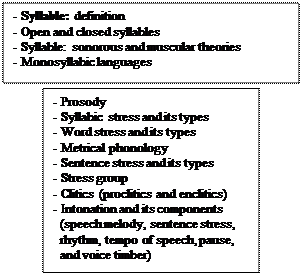
· Syllable is the minimal unit of organization for a sequence of speech sounds, acting as a unit of rhythm. It consists of an obligatory nucleus (typically, a vowel) with optional initial and final margins (typically, consonants).
E.g. /`pen/: /e/ – the nucleus; /p/, /n/ – the margins.
Structural classifications also recognize a division between an initial onset and a following rhyme (or rime). The rhyme is further subdivided into a peak followed by a coda. The onset corresponds to the initial margin, the peak to the nucleus, and the coda to the final margin. E.g. /`pen/: /p/ – the onset; /en/ – the rhyme; /e/ – the peak, /n/ – the coda.
A syllable ending in a vowel is an open syllable; one ending in a consonant is a closed, or checked, syllable. The division of a word into syllables is called syllabification. A segment which can act as a syllabic nucleus is described as syllabic. The number of syllables in a word equals to the number of syllabic segments.
· According to the sonorous theory, a syllable is the minimal portion of voice energy which has its peak (the maximum of voice) and the margins (the minimum of voice). The peak is a syllabic sound – a vowel or sonorant; the margins are consonants. According to the muscular theory, a syllable relates to the increase of muscular tension at the beginning and its decrease at the end of a syllable.
· In the majority of languages the division of a word into morphemes and its division into syllables do not coincide. However, there are languages where these divisions mostly coincide: here, all or most of the morphemes or words consist of single syllables. Such languages are called monosyllabic. E.g. Chinese, Thai, and Tibetan.
* * *
· Prosodyis the unity of stress and intonation.
· Syllabic stress is a phonetic property of syllables. It relates to the way in which a stressed syllable is singled out, or made more prominent, in a word. Types of syllabic stress:
(1) Dynamic stress: the stressed syllable is pronounced louder than the unstressed ones. This type of stress, combined with quantitative stress, is typical of Ukrainian, Russian, English, German, and many other languages. In Swedish, dynamic stress combines with musical stress.
(2) Quantitative stress: the stressed syllable is longer than the unstressed ones. This stress hardly occurs by itself. It integrates with the other types of stress. Quantitative stress is most salient in New Greek.
(3) Musical, or tone, stress: the stressed syllable has a particular pitch melody. The same syllable spoken with a different tone each time has a different meaning. Such languages are called tone languages. The examples are Chinese, Japanese, Korean, and Old Greek.
· Word stress relates to the location of stress in a word, and to the number of stresses with different degrees of prominence. Types of word stress:
(1) With regard to its location in a word the following types are distinguished:
a) Free word stress, which can rest on any syllable in a word; it can move from one syllable to another. The examples are set by Ukrainian, Russian, and English. E.g. Ukr. ліс – ліси – лісовий; Russ. дом – дома – дома – домашний; Engl. artist – artistic, subject – subject. The change of stress may cause the change of meaning.
b) Fixed word stress rests on one and the same syllable in all words. E.g. in Czech, Hungarian, Finnish, Estonian and Latvian stress rests on the first syllable; in French and in most Turkish languages stress rests on the last syllable; in Polish the last but one syllable is stressed.
c) Bound word stress is a kind of fixed stress which has a restricted zone within which it falls on a particular syllable. The example is Latin, where word stress rests on either the second or the third syllable from the end.
(2) Provided there are two stressed syllables in a word, they may differ in the degree of prominence. Accordingly, the distinction is made between:
a) Primary stress, which is more prominent, and
b) Secondary stress, which is less prominent. E.g. Engl. /a: tikju:`lei n/
‘articulation', /pr n nsi `ei n/ ‘pronunciation'.
· Metrical phonologystudies the interplay of stresses and unstressed syllables in words and word groups. (See 4).
· Sentence stress performs syntactic and semantic functions: it unites words into meaningful phrases. Sentence stress is a component of intonation. Sentence stress is based on the word stress. Types of sentence stress:
(1) 
 Phrasal, or syntagmatic, stress makes the phrase a syntactic whole where some words are stressed and some are unstressed. One of the stressed syllables (usually, that which is final) has a conventional tone associated with a particular meaning. Phrasal stress is compulsory for a sentence. E.g. Ukr. Вони навчаються в універси теті. Вони навчаються в универcи теті. Engl. They study at the uni versity. Do they study at the uni versity?
(2) Logical stress highlights the most important information, which may be conveyed by any word in the phrase, even that which is conventionally unstressed. The logically stressed word is pronounced louder than the other words. This type of stress is not compulsory for a sentence. E.g. Engl. THEY study at the university. Your book is UNDER the table. It is not ON the table. The cup ISN'T broken.
(3) Emphatic, or emotional, stress is intended for conveying the attitude of the speaker towards the highlighted information. Emphasis is exposed through the change of voice pitch. This type of stress is not compulsory for a sentence. E.g. Engl. It's so ``WONDERFUL. He knows``NOTHING about it (High Fall).
· Stress group is a sequence of syllables constituting a rhythm unit that contains one primary stress. A stress group may include one stressed word and one or more unstressed ones. As a rhythm unit, they make up ‘a phonetic word'. The unstressed words attached to the stressed one are called clitics. Clitics include enclitics and proclitics.
Enclitic is an unstressed word attached to the preceding stressed word. E.g. Ukr. сказав би; Russ. без вести, по миру, по воду; Engl. cannot.
Procliticis an unstressed word attached to the following stressed word. E.g. Ukr. на столі; Russ. мой дядя; Engl. an apple, my uncle.
· Intonation is a complex unity of speech melody, sentence stress, rhythm, tempo of speech, pauses, and voice timbre.
Speech melody is represented by variations of voice pitch produced by significant moves of the voice up and down.
Sentence stress: see above.
Rhythmis a regular flow of speech in which stressed and unstressed syllables occur at definite intervals. There are two kinds of rhythm: syllable-timed rhythm and stress-timed rhythm. In languages spoken with syllable-timed rhythm (e.g. French and Japanese), all syllables are of equal value; they follow each other with fairly equal length and force. The rhythm is even, based on a smooth flow of syllables without a strong contrast of stress. To an English-speaking person this kind of rhythm sounds mechanically regular. English with this kind of rhythm would be hard to understand. In languages with stress-timed rhythm (e.g. English, Ukrainian, Russian), there is alteration of strongly and weakly stressed syllables. It is the stress (stressed syllable) that occurs at fairly equal intervals of time.
Tempo of speechis the relative speed or slowness of utterance which is measured by the rate of syllable succession, and the number and duration of pauses in a sentence. The average rate of delivery may contain 2 to 4 syllables per second for slow speech (lento), from 3 to 6 syllables per second for normal speech, and 5 to 9 syllables per second for fast speech (allegro).
Pauseis an act of stopping in the flow of speech. Acoustically, a pause is the absence of sound. Physiologically, it is the absence of articulation. Pauses are used for physiological purposes (to inhale the air), for semantic purposes (to show the link between phrases or syntagms / `sint mz/), and for emphatic purposes (e.g. to express surprise, bewilderment, astonishment, etc).
Voice timbre is the ‘color' or ‘tonal quality' of voice. Timbre depends on the physiological properties and psychological state of a person.
LITERATURE:
1. Соколова М.А. и др. Практическая фонетика английского языка. М., 1984. Chapter 1: The Production of Speech (pp. 10 – 13).
2. Васильев В.А. English Phonetics. M., 1980. Chapter 1: The Organs of Speech and their Functions (pp. 15 – 16).
3. Жаботинская С.А. Методическая разработка по практической фонетике английского языка для студентов 1-3 курсов факультета иностранных языков. Часть 1. Основы теории: ЗВУКИ И СЛОВА. – Черкассы, ЧГПИ, 1988. (pp. 4-25; 32-40).
4. Aitchison, J. Linguistics. – Chicago, 1993. Chapter 5: Sound Patterns (pp. 37 – 47).
| <== previous lecture | | | next lecture ==> |
| Prof. S.A. Zhabotynska | | | Глава 1 |